
Nonlinear Optical Crystals
KTP Nonlinear Optical Crystals
KTP crystals for frequency doubling from 1064 to 532 nm, optical parametric conversion, and frequency mixing, with phase-matching cuts defined for the application.
- Germany-based supplier and manufacturing partner
- Manufacturing to customer specifications
- Optical inspection and measurement against specified requirements
- From single components and prototypes to repeat supply
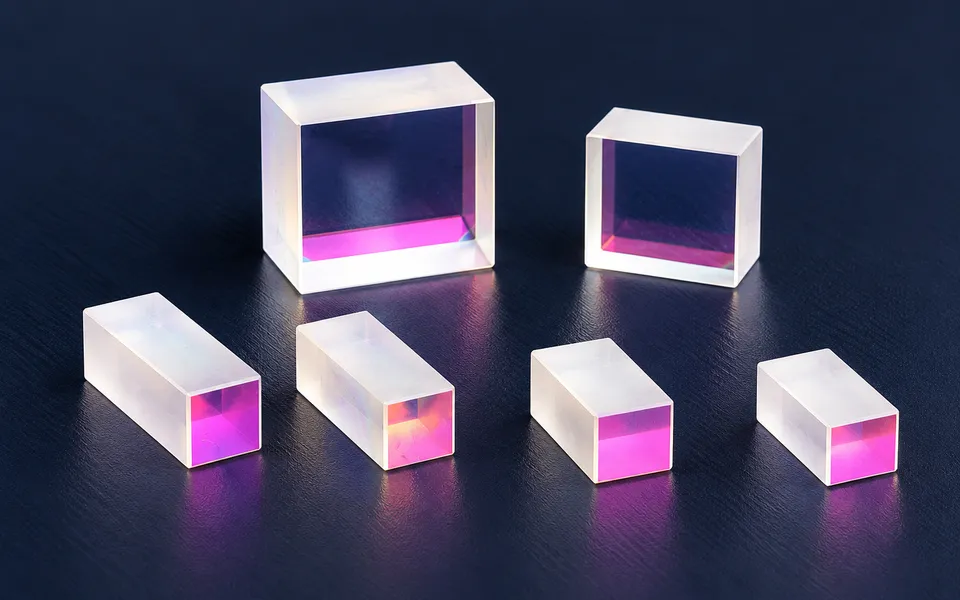
Product overview
Custom KTP crystals can be specified with application-specific orientations, dimensions, surface finish, and optical coatings.
KTP (potassium titanyl phosphate, KTiOPO₄) is a widely used nonlinear optical crystal for laser frequency conversion. One of its most common applications is Type II second-harmonic generation (SHG) of Nd-doped lasers, converting 1064 nm near-infrared radiation to 532 nm green light.
Its relatively high nonlinear coefficient, broad acceptance characteristics, low walk-off and good mechanical stability also make KTP suitable for optical parametric generation and oscillation, frequency mixing and selected electro-optic applications.
Key advantages
- High nonlinear optical coefficient
- Broad angular and temperature acceptance
- Low spatial walk-off
- Non-hygroscopic
- Good mechanical and chemical stability
- Broad transparency range
Typical specifications
| Cross-sectional dimensions | 2 × 2 mm to 10 × 10 mm |
|---|---|
| Crystal cut / phase-matching angles | θ and φ according to the required wavelength-conversion process |
| Phase-matching type | Type I or Type II |
| Surface flatness | < λ/8 at 633 nm |
| Surface quality | 10/5 scratch-dig |
| Parallelism | < 20 arcsec |
| Perpendicularity | < 5 arcmin |
| Chamfer | 0.15 mm × 45° |
Properties
Physical Properties
- Chemical formula
- KTiOPO₄
- Crystal structure
- Orthorhombic
- Space group / point group
- Pna2₁ / mm2
- Lattice parameters
- a = 6.404 Å; b = 10.616 Å; c = 12.814 Å; Z = 8
- Melting point
- 1172 °C
- Curie point
- 936 °C
- Mohs hardness
- 5
- Density
- 3.01 g/cm³
- Hygroscopic susceptibility
- Non-hygroscopic
- Thermal conductivity
- 13 W/(m·K)
- Thermal expansion coefficient
- αx = 11 × 10⁻⁶ K⁻¹; αy = 9 × 10⁻⁶ K⁻¹; αz = 0.6 × 10⁻⁶ K⁻¹
- Electrical conductivity
- 3.5 × 10⁻⁸ S/cm, c-axis, 22 °C, 1 kHz
Linear Optical Properties
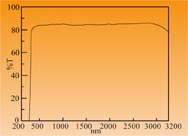
- Transparency range
- 350–4400 nm
- Refractive indices at 1064 nm
- nx = 1.7404; ny = 1.7479; nz = 1.8296
- Refractive indices at 532 nm
- nx = 1.7797; ny = 1.7897; nz = 1.8877
- Thermo-optic coefficients
- ∂nx/∂T = 1.1 × 10⁻⁵ K⁻¹; ∂ny/∂T = 1.3 × 10⁻⁵ K⁻¹; ∂nz/∂T = 1.6 × 10⁻⁵ K⁻¹
- Sellmeier equation, nx (λ in µm)
- nx² = 3.0067 + 0.0395 / (λ² − 0.04251) − 0.01247λ²
- Sellmeier equation, ny (λ in µm)
- ny² = 3.0319 + 0.04152 / (λ² − 0.04586) − 0.01337λ²
- Sellmeier equation, nz (λ in µm)
- nz² = 3.3134 + 0.05694 / (λ² − 0.05941) − 0.016713λ²
Nonlinear Optical Properties
- Type II SHG phase-matching range, x-y plane
- 0.99–1.08 µm
- Type II SHG phase-matching range, x-z plane
- 1.1–3.4 µm
- Type II SHG at 1064 nm
- θ = 90°, φ = 23.5°
- Walk-off
- Approx. 4 mrad
- Angular acceptance
- Δθ ≈ 55 mrad·cm; Δφ ≈ 10 mrad·cm
- Thermal acceptance
- ΔT ≈ 22 K·cm
- Spectral acceptance
- 0.56 nm·cm
- Electro-optic coefficient r13
- Low frequency: 9.5 pm/V; High frequency: 8.8 pm/V
- Electro-optic coefficient r23
- Low frequency: 15.7 pm/V; High frequency: 13.8 pm/V
- Electro-optic coefficient r33
- Low frequency: 36.3 pm/V; High frequency: 35.0 pm/V
- Electro-optic coefficient r51
- Low frequency: 7.3 pm/V; High frequency: 6.9 pm/V
- Electro-optic coefficient r42
- Low frequency: 9.3 pm/V; High frequency: 8.8 pm/V
Representative examples
6 × 6 × 16 mm, OPO pumped at 532 nm
- θ = 64°, φ = 0°
- AR coating at 532 nm and 840–880 nm
2 × 2 × 5 mm, Type II SHG at 1064 nm
- AR coating at 1064 / 532 nm
2 × 2 × 7 mm, SHG at 1064 nm
- AR coating at 1064 / 532 nm
5 × 5 × 10 mm, x-cut
- AR coating at 1064 nm and 1570–1590 nm
Show more examples (4)Show fewer examples
5 × 5 × 2 mm, SHG at 1064 nm
- S1: HR at 1064 nm, R > 99.8%; HT at 532 nm, T > 97%
- S2: AR at 1064 / 532 nm, R < 0.25%
3 × 3 × 10 mm, SHG at 1064 nm
- S1: AR at 1064 nm, R < 0.25%; HR at 532 nm, R > 99.7%
- S2: AR at 1064 / 532 nm, R < 0.25%
10 × 10 × 7 mm, Type II SHG at 1064 nm
- AR coating at 1064 / 532 nm
6 × 8 × 15 mm, Type II OPO pumped at 1064 nm
- θ = 55°, φ = 0°
- AR coating at 1064 nm and 1.91–2.4 µm
Typical applications
- Second-harmonic generation (SHG), particularly 1064 to 532 nm
- Optical parametric generation, amplification, and oscillation (OPG/OPA/OPO)
- Sum- and difference-frequency generation (SFG/DFG)
- Selected electro-optic modulation and switching applications
View related products
LBO Nonlinear Optical Crystals
For SHG, THG, and OPO, with options for custom phase-matching cuts, dimensions, surface finish, and optical coatings.
BBO Nonlinear Optical Crystals
For SHG, UV harmonic generation, and OPO/OPA, with options for custom crystal cuts, dimensions, and optical coatings.

Nd:YAG Laser Crystals
For diode-pumped and lamp-pumped lasers, with custom doping levels, dimensions, end-face geometries, and coatings.
Nd:YVO₄ Laser Crystals
For compact 1064 nm diode-pumped lasers, with strong pump absorption, high gain, and polarized emission.
RFQ PREPARATION
What to send for a quote
Please send your drawing or technical specification together with the following information.
- Input and output wavelengths and frequency-conversion process
- Phase-matching type and required crystal cut / orientation
- Crystal dimensions and critical optical tolerances
- Coating wavelengths and S1 / S2 requirements
- Required quantity