
Nonlinear Optical Crystals
BBO Nonlinear Optical Crystals
BBO crystals for UV harmonic generation and optical parametric oscillator (OPO) or amplifier (OPA) applications, with crystal cuts specified for phase matching.
- Germany-based supplier and manufacturing partner
- Manufacturing to customer specifications
- Optical inspection and measurement against specified requirements
- From single components and prototypes to repeat supply
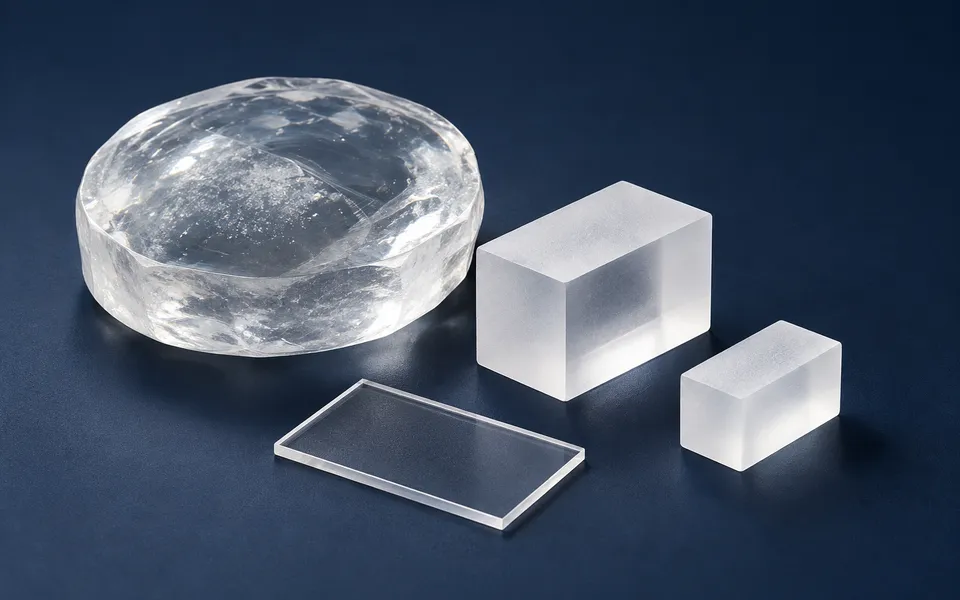
Product overview
Custom BBO crystals can be specified by crystal cut, dimensions, surface requirements, and optical coatings.
BBO (beta barium borate, β-BaB₂O₄) is a negative uniaxial nonlinear optical crystal widely used for laser frequency conversion. It supports both Type I and Type II angle phase matching and is commonly used for second-harmonic generation (SHG), sum-frequency generation (SFG), optical parametric oscillation (OPO), and optical parametric amplification (OPA).
BBO is particularly suitable for visible and ultraviolet frequency conversion. In Nd-based laser systems, it is commonly used in frequency-conversion stages generating 532 nm, 355 nm, 266 nm, and 213 nm from a 1064 nm fundamental wavelength.
Key advantages
- Broad transparency range of approximately 190–3500 nm
- Broad phase-matching ranges for Type I and Type II interactions
- Large effective nonlinear coefficient
- High laser-induced damage threshold
Typical specifications
| Rectangular cross-section | 4 × 4 mm to 12 × 12 mm |
|---|---|
| Length | 4–14 mm Other dimensions available on request. |
| Dimensional tolerance | (W ±0.1 mm) × (H ±0.1 mm) × (L +0.2 / −0.1 mm) |
| Phase-matching angle (θ, φ) | According to wavelength and application |
| Phase-matching type | Type I or Type II |
| Cut-angle tolerance | ±0.5° |
| Surface flatness | λ/8 at 633 nm |
| Surface quality | 10-5 scratch-dig |
| Parallelism | < 20 arcsec |
| Perpendicularity | < 5 arcmin |
| Clear aperture | ≥ 90% of full aperture |
| Chamfer | According to crystal dimensions |
| Coating options | Protective coatings and single-band, dual-band, or broadband AR coatings available on request |
Properties
Physical and Chemical Properties
- Crystal structure
- Trigonal
- Space group
- R3c
- Optical character
- Negative uniaxial
- Lattice parameters
- a = b ≈ 12.532 Å; c ≈ 12.717 Å; Z = 6
- Density
- 3.85 g/cm³
- Melting point
- 1095 °C
- α–β phase transition
- 925 °C
- Mohs hardness
- 4.5–5
- Absorption coefficient
- < 0.1%/cm at 1064 nm
- Resistivity
- > 1 × 10¹¹ Ω·cm
- Thermal expansion
- 25–900 °C: αₐ = 4 × 10⁻⁶ K⁻¹; αc = 36 × 10⁻⁶ K⁻¹
- Thermal conductivity
- 1.2 W/(m·K) ⟂ c; ≈ 1.6 W/(m·K) ∥ c
- Hygroscopic susceptibility
- Low; dry storage is recommended
Linear Optical Properties
- Transparency range
- 189–3500 nm
- Refractive indices at 1064 nm
- nₑ ≈ 1.5392; nₒ ≈ 1.6545
- Refractive indices at 532 nm
- nₑ ≈ 1.5547; nₒ ≈ 1.6742
- Refractive indices at 266 nm
- nₑ ≈ 1.6126; nₒ ≈ 1.7585
- Thermo-optic coefficients
- dnₒ/dT = −9.3 × 10⁻⁶ K⁻¹; dnₑ/dT = −16.6 × 10⁻⁶ K⁻¹
- Sellmeier equation for nₒ (λ in µm)
- nₒ² = 2.7359 + 0.01878 / (λ² − 0.01822) − 0.01354λ²
- Sellmeier equation for nₑ (λ in µm)
- nₑ² = 2.3753 + 0.01224 / (λ² − 0.01667) − 0.01516λ²
Nonlinear Optical Properties
- Phase-matchable output wavelength range
- 189–1750 nm
- Type I effective coefficient
- d_eff = d31 sinθ + (d11 cos3φ − d22 sin3φ) cosθ
- Type II effective coefficient
- d_eff = (d11 sin3φ + d22 cos3φ) cos²θ
- Electro-optic coefficient
- r₂₂ = 2.7 pm/V
- Reference bulk damage threshold
- At 1064 nm: 5 GW/cm², 10 ns At 1064 nm: 10 GW/cm², 1.3 ns At 532 nm: 1 GW/cm², 10 ns At 532 nm: 7 GW/cm², 250 ps
Typical applications
- SHG of 1064 nm laser radiation for 532 nm output
- Third-, fourth-, and fifth-harmonic generation of 1064 nm lasers (355, 266, and 213 nm)
- Sum-frequency generation (SFG) and other nonlinear frequency-mixing processes
- Optical parametric oscillation and amplification (OPO/OPA) for tunable laser sources
- Visible and ultraviolet frequency conversion in pulsed solid-state laser systems
View related products
LBO Nonlinear Optical Crystals
For SHG, THG, and OPO, with options for custom phase-matching cuts, dimensions, surface finish, and optical coatings.
KTP Nonlinear Optical Crystals
For SHG, OPO, and frequency-mixing applications, with options for custom crystal cuts, dimensions, and optical coatings.
Nd:YAG Laser Crystals
For diode-pumped and lamp-pumped lasers, with custom doping levels, dimensions, end-face geometries, and coatings.
RFQ PREPARATION
What to send for a quote
Please send your drawing or technical specification together with the following information.
- Input and output wavelengths and frequency-conversion process
- Phase-matching type and crystal cut / orientation
- Crystal dimensions and critical optical tolerances
- Coating wavelengths and S1 / S2 requirements
- Required quantity